How to Choose a Nursing Home for a Parent with Dementia
Dementia-Specific Units vs. Memory Care: What Families Need to Know
When a parent's dementia progresses to the point where round-the-clock medical supervision is necessary, families often assume the only option is a standalone memory care facility. That is not the full picture. Many nursing homes operate dedicated dementia-specific units: secured, specialized areas within the larger facility designed for residents with Alzheimer's disease or other forms of cognitive impairment.
Here is the core distinction. A standalone memory care community is typically licensed as assisted living under state regulations, which vary enormously from state to state. A nursing home dementia unit, by contrast, falls under federal Medicare and Medicaid oversight. That means certified nursing assistants on staff, a licensed nurse on duty around the clock, and standardized inspection reports you can actually read.
Cost matters, and the numbers differ. National median figures from the Alzheimer's Association have placed a nursing home private room above $9,700 per month and memory care around $6,900 per month, though those figures shift every year and vary dramatically by region. A private room in rural Arkansas costs far less than one in suburban Boston. Check your state's Medicaid agency website or a tool like the Genworth Cost of Care Survey for local numbers. Do not rely on national medians alone.
Choose a nursing home dementia unit when your parent has complex medical needs on top of cognitive decline: diabetes requiring insulin management, a feeding tube, wound care, frequent infections, or a history of falls severe enough to need skilled rehabilitation. If the medical picture is relatively stable and the primary need is supervision and structured activities, a memory care assisted living community may be the better fit.
What If the Nursing Home Does Not Have a Dedicated Dementia Unit?
Many nursing homes, especially in rural areas, do not have a separate dementia wing. They accept residents with dementia into the general population. This is not automatically a red flag, but it demands extra scrutiny.
Ask specifically how the facility manages residents with cognitive impairment alongside those who are cognitively intact. Key questions include:
- How are residents grouped? Are there designated hallways or dining times for residents with dementia, or is everyone mixed together at all hours?
- Is there a wandering prevention system in place facility-wide? In a mixed-population building, door alarms and monitoring need to cover every exit, not just one wing.
- How do staff handle behavioral symptoms in shared spaces? A resident who becomes agitated during mealtime in a shared dining room needs a calm, trained response, not just redirection to a room alone.
If the facility cannot describe a clear, structured approach to dementia care within its general population, keep looking.
Evaluating Staff Training in Dementia Care
Every facility will tell you their staff is "dementia-trained." Your job is to find out what that actually means.
Look for specific, verifiable credentials. The Certified Dementia Practitioner (CDP) designation, training through the Alzheimer's Association's essentiALZ program, or accreditation from CARF International are concrete markers. General in-service hours are a start, but they are not enough on their own.
How to Verify, Not Just Ask
Families often ask about training hours and get a vague answer. Push further:
- Request a copy of the training curriculum. A facility that takes dementia care seriously will have a written program it can show you. If the administrator hesitates or says it is "proprietary," that is worth noting.
- Ask to speak directly with the Director of Nursing. Ask them: "What specific dementia care competencies do you assess in your CNAs? How often?" The answer should include concrete skills like redirection techniques, communication strategies for different stages of dementia, and recognizing pain in nonverbal residents.
- Ask about ongoing education. Initial training matters, but annual refreshers matter more. A facility that trains staff once during orientation and never again is not keeping up.
- Observe a shift change or activity hour if possible. Watch how staff interact with residents. Do they make eye contact? Speak at the resident's level? Use the resident's name? Are they patient when a resident repeats the same question for the fifth time?
Staffing stability tells you as much as training quality. High turnover means your parent will constantly face unfamiliar caregivers, which is especially destabilizing for someone with dementia. You can check a facility's staffing data and turnover rates on Medicare's Care Compare tool. Turnover above 45 to 50% annually is a warning sign.
Safety Features: Balancing Protection with Dignity
The Alzheimer's Association reports that roughly 6 in 10 people with dementia will wander at some point. Falls are the leading cause of injury among older adults, according to the CDC. Safety infrastructure is non-negotiable.
Look for:
- Alarmed exits and monitored doors throughout the building, not just on one wing
- Enclosed outdoor areas such as secure garden paths where residents can walk freely
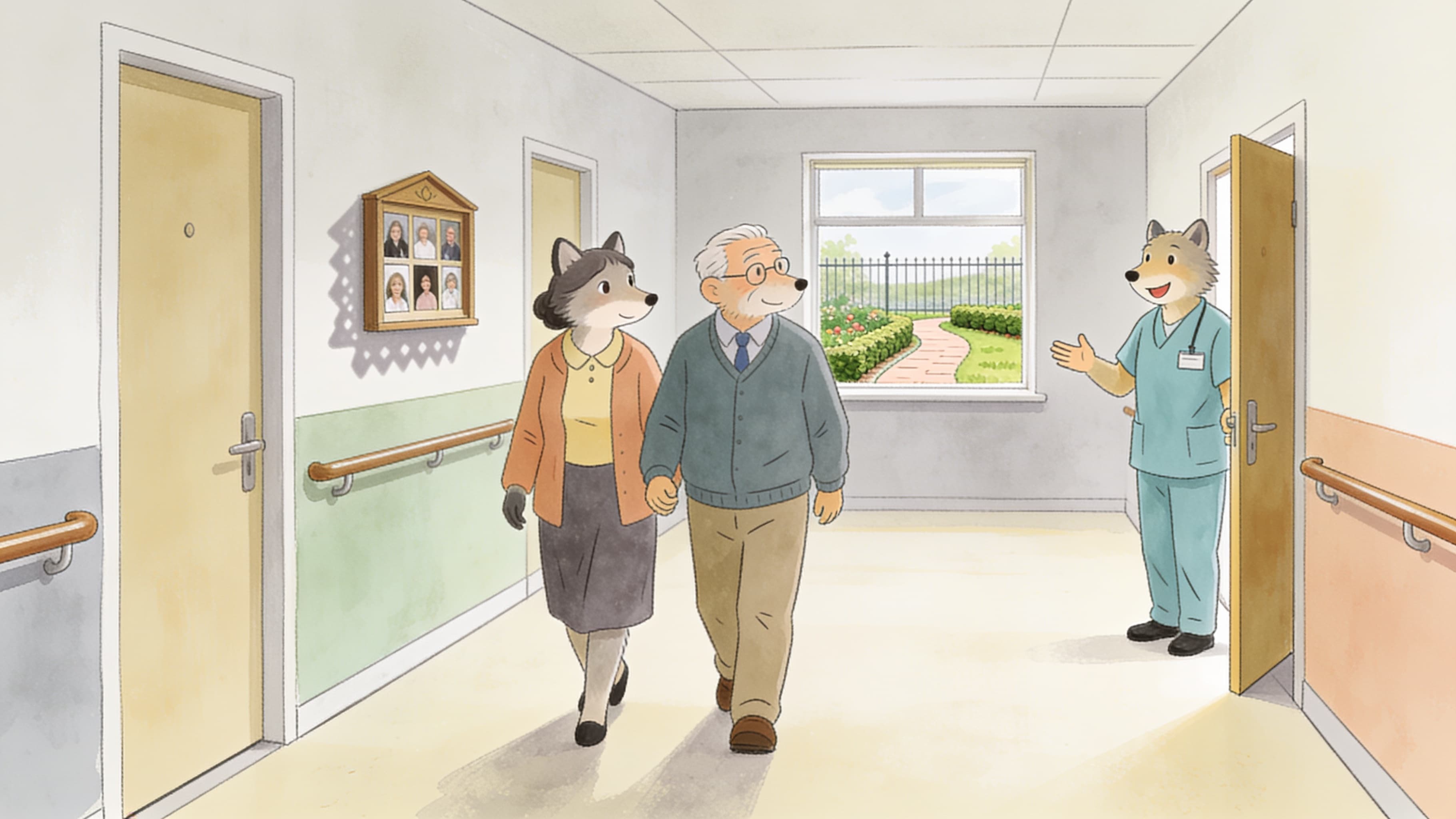
- Fall prevention features like handrails in every hallway, non-slip flooring, low-profile beds, and call buttons within reach of every bed and toilet
- Medication management protocols, especially around psychotropic drugs. Ask: "What is your policy on using antipsychotics for behavioral symptoms?"
- An elopement response plan. If a resident does get out, what happens in the first five minutes?
The Dignity Question
Here is where families need to think carefully. A locked unit keeps your parent from wandering into traffic. It also restricts their freedom. The best facilities use the least restrictive option first: a wander garden before a locked door, a motion sensor before a physical restraint, music therapy or a calm environment before a sedating medication.
Ask the facility directly: "How do you balance safety with residents' autonomy?" and "What non-pharmacological interventions do you use before considering medication for agitation?" A good answer will describe a layered approach. A bad answer will be a blank stare.
Check Medicare Care Compare for the facility's antipsychotic medication usage rate. Facilities that rely heavily on chemical restraints will show higher percentages. Compare that number against the national average.
Assessing the Physical Environment
The physical space tells you a great deal about how a facility thinks about dementia care.
Walk the hallways. Are they clearly differentiated? Color-coded corridors and distinct visual landmarks help residents with dementia orient themselves. The National Institute on Aging recommends visual cues as a core element of dementia-friendly design.
Look for:
- Memory boxes or shadow boxes outside each resident's room containing personal photos and familiar objects. These help a resident find their own door.
- Contrasting colors on bathroom fixtures. A white toilet against a white floor is nearly invisible to someone with impaired depth perception. A contrasting seat makes a real difference.
- Secure outdoor space with walking paths. Access to fresh air and sunlight reduces agitation and can help with sundowning.
- Noise levels. Stand in the common area for ten minutes. Are there constant overhead announcements? Blaring televisions? A calm environment matters more for dementia residents than for almost anyone else in the building.
Asking About Cultural Competence, Language, and Inclusivity
Dementia does not erase a person's cultural identity, language, or life history. As the disease progresses, many people revert to their first language or find deep comfort in familiar cultural traditions. A facility that cannot accommodate these needs will leave your parent more isolated.
During your tour, ask:
- Are interpreter services available? If your parent's primary language is not English, consistent access to staff or interpreters who speak that language is essential, not optional.
- Can meals reflect cultural or religious dietary needs? This is about more than preference. Familiar food can be one of the last remaining sources of comfort.
- Does the facility have a written non-discrimination policy that includes sexual orientation and gender identity? For LGBTQ+ older adults, this is a safety concern, not a formality.
- Has the facility ever been cited in state inspection reports for discrimination or neglect related to cultural or identity-based issues? You can search inspection reports through your state health department's website.
These are not luxury questions. They are baseline quality indicators.
Key Questions to Ask During Facility Tours
Bring this list on paper. Ask these questions of the administrator, the Director of Nursing, and at least one frontline CNA if you can.
- What is the staff-to-resident ratio during the day shift? During nights and weekends? (For dementia units, 1:8 or better is a reasonable benchmark.)
- How do you handle aggressive or agitated behavior? Describe your de-escalation protocol.
- What structured activities do you offer specifically for residents with dementia? (Look for music therapy, pet therapy, reminiscence groups, sensory stimulation, not just a television in a common room.)
- How do you involve families in care planning? Are there family council meetings? How often will I receive updates on my parent's condition?
- Can I visit unannounced at any time? (Federal law gives you this right in a Medicare/Medicaid-certified nursing home. A facility that discourages it is waving a red flag.)
- May I see your most recent state inspection survey? (They are required to post it, but ask anyway and watch the reaction.)
Comparing Costs and Payment Options
Nursing home care is expensive, and dementia care often costs more than standard skilled nursing. Understanding your payment options early prevents a crisis later.
- Medicaid covers nursing home care for those who qualify financially. Standalone memory care facilities, licensed as assisted living, are often not covered by Medicaid unless your state offers a home and community-based services waiver. This is a major practical reason some families choose a nursing home dementia unit.
- Medicare does not cover long-term nursing home stays. It covers short-term skilled nursing after a qualifying hospital stay, typically up to 100 days, and only under specific conditions. See Medicare.gov for details.
- Long-term care insurance may cover dementia care, but read the policy carefully. Check the elimination period, daily benefit amount, and whether cognitive impairment triggers benefits.
- Private pay bridging is a strategy families use when a parent needs nursing home care now but has not yet qualified for Medicaid. Our guide on private pay bridge strategies walks through the options. If your parent has very limited resources, see our article on how to pay for memory care with no savings. And if you are wondering what happens to your parent's income once they move in, read what happens to Social Security and pension in a nursing home.
This article provides general information and is not a substitute for professional legal or financial advice.
Making the Decision: A Comparison Framework
After touring two or three facilities, the details blur together. A simple scoring system helps.
Create a spreadsheet or a sheet of paper with these categories across the top: Staff Training and Stability, Safety Features, Physical Environment, Activities and Engagement, Cost and Payment Options, Cultural Competence, and Location. Rate each facility on a scale of 1 to 5 in every category. Weight the categories that matter most to your family.
Pull each facility's five-star rating from Medicare Care Compare, but do not stop there. Read the inspection reports. Look at the staffing data. A facility can have four stars overall and still have a serious deficiency in infection control or staffing.
If your parent can participate in a visit, bring them. Watch their reaction to the space and the people. A parent with moderate dementia may not be able to articulate a preference, but you will see whether they seem calm or distressed.
Trust what you observe over what you are told.
Transitioning to the Facility
Imagine a daughter who has spent months researching, touring, and comparing. She has chosen a facility. Now comes the hardest day.
Plan the move during your parent's best time of day, often mid-morning for many people with dementia. Bring familiar items: a favorite blanket, family photos, a clock they have had for decades. These objects anchor a person in a strange new place.
Stay for the first few hours. Introduce your parent to the staff by name. Share a brief written summary of your parent's preferences, habits, and triggers with the nursing team. "Dad gets anxious around loud noises." "Mom responds well to gospel music." This information matters more than you might think.
In the weeks that follow, monitor closely. Unplanned weight loss, new bruises, increased agitation, or sudden behavioral changes can signal problems. Visit at different times of day, including evenings and weekends. If something concerns you, document it and bring it to the Director of Nursing. If the response is inadequate, contact your state's long-term care ombudsman. You can find your local ombudsman through the Eldercare Locator.
Your parent cannot always advocate for themselves. That is your role now, and it does not end on move-in day.
Sources & further reading
- Alzheimer's Disease Facts and Figures · Alzheimer's Association
- Care Compare: Find and compare nursing homes, hospitals, and other providers · Medicare.gov
- Skilled Nursing Facility (SNF) Care · Medicare.gov
- Safety: Caregiving · Alzheimer's Association
- Falls Prevention · Centers for Disease Control and Prevention
- Alzheimer's Caregiving · National Institute on Aging
- Eldercare Locator · Administration for Community Living
Related Articles
When Home Care Isn’t Enough: 7 Signs It’s Time for Assisted Living or Memory Care
A practical checklist of 7 signs that home care is no longer safe or sustainable, guiding families toward assisted living or memory care.
Memory Care in Oregon: Licensing, Costs, and What Families Should Look For in 2026
Oregon's memory care costs and regulations explained. How to verify dementia training, compare communities, and budget for 2026.
Private Pay vs. Government Assistance: How Senior Care Actually Gets Paid For
Home care, assisted living, and nursing homes are funded very differently. A plain-language map of private pay versus Medicare, Medicaid, and VA support, setting by setting.