Memory Care vs. Assisted Living in Texas: Licensing, Staffing, and What Families Must Verify
Understanding the Difference: Memory Care vs. Assisted Living in Texas
If you're an adult child researching care options for a parent in Houston, Dallas, Austin, or San Antonio, you've probably noticed that "memory care" and "assisted living" are used almost interchangeably in facility marketing. Texas draws the line differently than you might expect.
Texas Health and Human Services Commission (HHSC) licenses assisted living facilities (ALFs) under two categories: Type A (small homes with up to 10 residents) and Type B (11 or more residents). There is no separate "memory care license." Instead, a facility that wants to serve residents with Alzheimer's disease or a related dementia must obtain an Alzheimer's certification from HHSC, which functions as an add-on to the base ALF license.
That certification, governed by Texas Administrative Code §92.41, requires a secured environment with wander-prevention measures, dementia-specific staff training, and a written plan of care for each resident. Without it, a facility is not authorized to market or deliver memory care services.
The practical difference for your family: assisted living residents generally need help with activities of daily living (bathing, dressing, medication reminders) but can move about freely. Memory care residents typically carry a dementia diagnosis and need 24/7 supervision, structured cognitive activities, and secured exits to prevent elopement.
Here's the catch. Some facilities advertise "memory care" without holding the certification. Always verify directly through HHSC's provider search or by calling the HHSC long-term care line. Marketing language is not a substitute for a posted, active certification.
Texas Licensing Requirements: What the State Mandates
Every ALF in Texas undergoes an initial licensing survey, then annual unannounced inspections by HHSC. If a facility also seeks Alzheimer's certification, it must submit a separate application and pass an additional survey covering 12 specific standards. These include:
- A minimum of 8 hours of initial dementia training for every staff member who works with certified residents, plus 4 hours of annual continuing education.
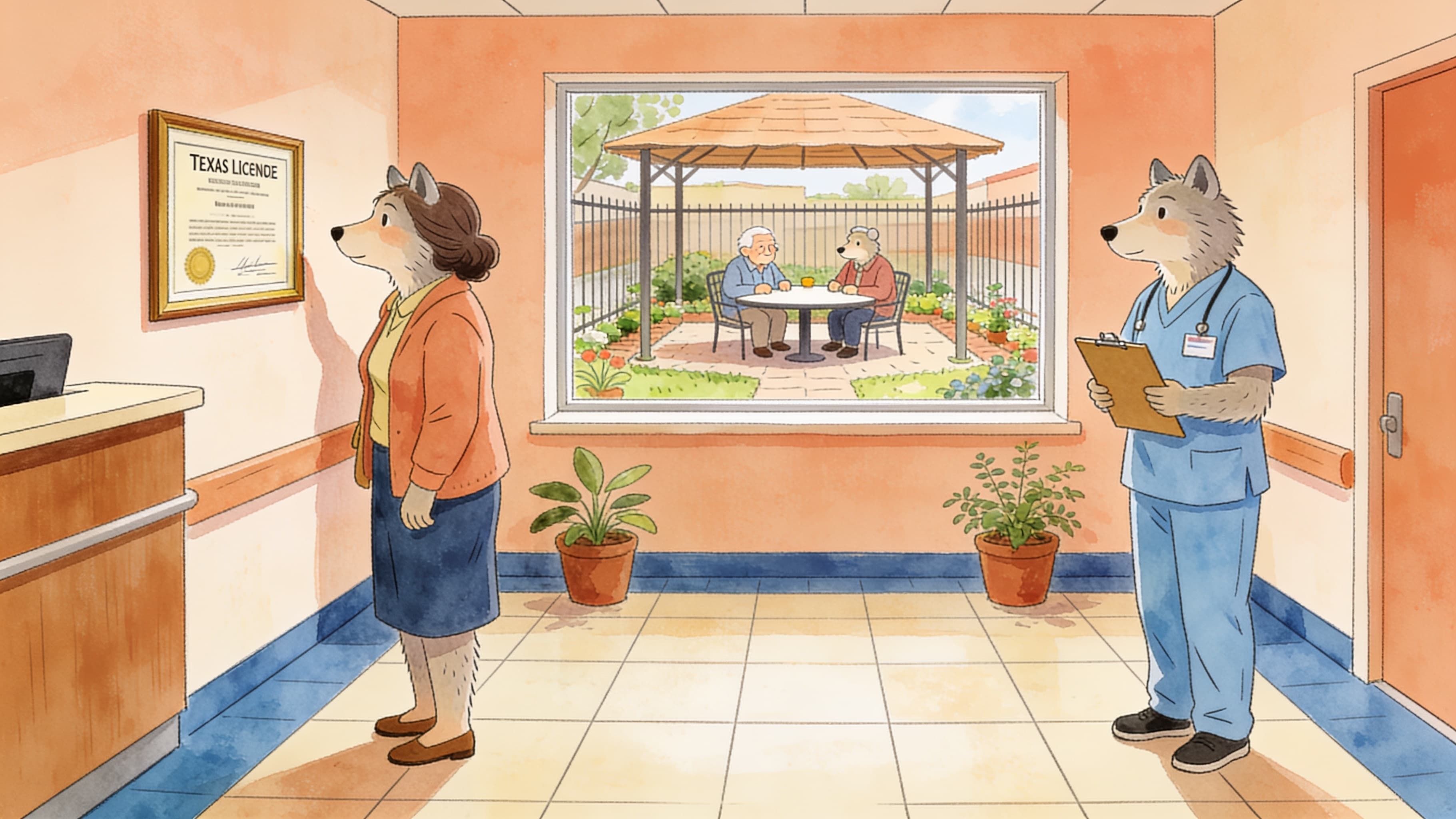
- A secured outdoor area where residents can spend time safely.
- A specialized activities program designed for varying cognitive levels.
- Written individualized care plans reviewed at least quarterly.
As of 2025, Texas had more than 1,800 licensed ALFs statewide, but only about 300 held Alzheimer's certification. That gap matters. It means roughly five out of every six assisted living facilities in Texas are not certified to provide memory care, even though some may house residents with early-stage dementia under their general license.
Inspection reports for every licensed facility are publicly available through HHSC's Facility Survey Results page. You can search by facility name or city to see deficiency citations, complaint investigations, and any enforcement actions. We'll walk through how to read those reports in the checklist section below.
Staffing Ratios and Training: Texas Regulations vs. Best Practices
Texas does not mandate a specific staff-to-resident ratio for general assisted living. The law requires "sufficient staff" to meet resident needs, which is vague by design and leaves wide variation from one facility to the next.
For certified memory care, the standard is slightly more concrete: Texas Administrative Code §92.41(d) requires at least one direct care staff member per 15 residents during waking hours. That is the legal floor.
The Alzheimer's Association's Dementia Care Practice Recommendations suggest ratios of 1:6 for residents with moderate dementia and 1:4 for those with advanced dementia. Those figures are aspirational benchmarks, not enforceable standards in any state. No Texas facility is legally required to meet them, and in practice, most do not.
So what is typical? Based on HHSC survey data and reporting from organizations like AARP, many Texas memory care communities staff at ratios between 1:8 and 1:12 during daytime hours, dropping to 1:15 or lower overnight. That range gives you a realistic yardstick. A facility telling you they maintain 1:8 during the day is operating well above the state minimum. A facility at exactly 1:15 is doing the bare legal requirement.
On training, the state's 8-hour initial requirement is modest. National dementia care experts recommend 40 or more hours of specialized training for direct care workers. Ask any facility you're evaluating how many training hours their staff actually complete and whether they use a recognized curriculum.
Staff turnover is another critical metric. Annual turnover rates above 50% are common in Texas senior care, and high turnover disrupts the continuity that dementia residents depend on. Ask for the number directly. If a facility won't share it, that tells you something.
For families coordinating medication management across care levels, our guide on how to manage a parent's medications in assisted living covers what to expect and what to ask.
What Families Must Verify: A Step-by-Step Checklist
Researching a facility from out of state (and many of you are, coordinating from Chicago or New York for a parent in the DFW Metroplex) can feel overwhelming. Here's a concrete process.
Step 1: Check License and Certification Status
Go to HHSC's provider portal and search by the facility's name or city. Confirm the license is active, check for any current enforcement actions, and look for the Alzheimer's certification and its expiration date. If the site is hard to use (and it can be), call HHSC directly at 512-438-3011 and ask them to verify the facility's status over the phone.
Step 2: Read the Last Three Inspection Reports
On the HHSC Survey Results page, pull up the facility's most recent inspection reports. Look specifically for citations related to medication errors, infection control, and resident elopement. Here's how to interpret what you find: imagine you search for a facility in Houston and see a citation for "failure to maintain secured exits." That citation will include a severity tag. "Actual harm" means a resident was injured or endangered. "Potential harm" means the risk existed but no one was hurt yet. Both matter, but actual harm citations deserve serious scrutiny.
If the same deficiency appears across two or three consecutive inspections, that pattern suggests the facility either cannot or will not fix the problem.
Step 3: Request the Written Staffing Schedule
Ask the facility to share their staffing schedule for day, evening, and overnight shifts. Calculate the ratio yourself by dividing the number of residents by the number of direct care staff on each shift. For memory care, also ask whether a licensed nurse (LVN or RN) is on-site 24/7 or only on call.
Step 4: Observe a Meal and an Activity
Visit during lunch or a group activity session. In a quality memory care program, activities should be small-group, structured, and adapted to different cognitive levels. Watch whether staff address residents by name, redirect gently when someone is confused, and engage with patience rather than rushing through tasks. Our article on occupational therapy in senior care explains how therapeutic programming fits into daily life.
Step 5: Verify Emergency Preparedness
Memory care units must have wander-prevention systems: door alarms, keypad-locked exits, and monitoring technology. Ask to see the evacuation plan specifically for residents with dementia. In Texas, hurricane preparedness is not optional. Ask how the facility handled its last weather event and whether they shelter in place or evacuate.
Red Flags and Green Flags: Texas-Specific Warning Signs
Red Flags
Uncertified "memory care." If a facility markets memory care services but does not hold HHSC Alzheimer's certification, that is a violation of state rules. It may also mean inadequate training, no secured environment, and no specialized care plans. Walk away.
Repeated citations for the same deficiency. A single citation for a medication management error might reflect a one-time lapse. The same citation two or three years running points to a systemic problem.
Certification does not guarantee quality. This is worth saying plainly. Texas's Alzheimer's certification standards are a baseline, not a seal of excellence. A facility can hold certification and still deliver mediocre care if staffing is at the bare minimum and training barely exceeds the required hours. Check the facility's complaint history and the severity of any deficiency citations. A certified facility with multiple "actual harm" findings deserves the same skepticism as one without certification at all.
Green Flags
An active Family Council. Texas requires ALFs to allow family councils, but the best facilities actively support them. A council that meets regularly and influences policy decisions signals transparency.
Low staff turnover. Ask how long the average direct care worker has been employed. Facilities where aides stay two years or more tend to deliver more consistent, personalized care.
STAR+PLUS Medicaid participation. Facilities that accept Texas's STAR+PLUS Medicaid waiver for memory care have agreed to meet higher accountability standards for low-income residents. Participation is voluntary and suggests a facility willing to submit to additional oversight.
Cost Context: Memory Care vs. Assisted Living in Texas Cities
Cost data for senior care shifts year to year, especially given the inflationary pressures that have hit the industry since 2020. The figures below draw from Genworth's Cost of Care Survey (the most recent edition available as of mid-2026) and should be treated as ballpark ranges, not guarantees. Always request a current quote directly from any facility you're considering.
The statewide median for assisted living in Texas runs roughly $4,500 to $5,000 per month. Memory care typically carries a premium, but the size of that premium varies significantly by market:
- Houston: Assisted living around $4,200 to $4,600; memory care $5,500 to $6,200. The premium here runs about 30 to 40%.
- Dallas-Fort Worth: Assisted living $4,800 to $5,200; memory care $6,000 to $6,800. Expect a 25 to 35% premium.
- Austin: Assisted living $5,000 to $5,500; memory care $6,300 to $7,000. Austin's tight real estate market pushes both figures higher.
- San Antonio: Assisted living $3,800 to $4,300; memory care $5,000 to $5,800. The premium can reach 35 to 45% here because the base rate is lower.
- Rural areas: In smaller Texas markets, the gap between assisted living and memory care can widen to 40 to 50% because fewer certified facilities exist and demand outstrips supply.
The national shorthand that memory care costs "20 to 30% more" than assisted living does not always hold in Texas. City-level variation is real, and rural families may face even steeper premiums.
Medicare does not cover room and board in assisted living or memory care. Texas Medicaid, through the STAR+PLUS waiver, may cover some memory care costs for eligible low-income seniors. Apply through HHSC or your local Area Agency on Aging. Families with long-term care insurance policies should review our guide to long-term care insurance for details on filing claims and understanding benefit triggers.
When reviewing a facility's pricing, ask for a detailed monthly fee breakdown. Many memory care communities quote a base rate that covers room and meals, then add "level of care" charges for ADL assistance, medication management, or specialized therapies. Those add-ons can increase the monthly bill by $500 to $1,500.
Resources and Next Steps: Where to Get Help in Texas
Texas families have several free resources for evaluating care options and filing complaints:
- Texas HHSC Long-Term Care Ombudsman Program: Advocates for residents in licensed facilities and investigates complaints. Reach them at 1-800-458-9858.
- Area Agencies on Aging (AAAs): Your local AAA, accessible through HHSC, offers free counseling on care options, Medicaid applications, and caregiver support.
- Alzheimer's Association Texas Chapter: Provides care consultation, local support groups, and a 24/7 helpline at 1-800-272-3900.
- 2-1-1 Texas: Dial 2-1-1 from any Texas phone for referrals to local senior services, including memory care options and financial assistance programs.
- Aging and Disability Resource Centers (ADRCs): One-stop offices in most Texas counties that help families compare long-term care options side by side.
If you're coordinating from another state, start with 2-1-1 Texas or the Alzheimer's Association helpline. Both can guide you to county-level resources without requiring you to be physically present.
This article provides general information about Texas senior care licensing and costs. It is not legal, financial, or medical advice. Consult a qualified professional for guidance specific to your family's situation.
Sources & further reading
- Long-Term Care Services · Texas Health and Human Services Commission
- Dementia Care Practice Recommendations · Alzheimer's Association
- Alzheimer's Association Texas Chapter · Alzheimer's Association
Related Articles
When Home Care Isn’t Enough: 7 Signs It’s Time for Assisted Living or Memory Care
A practical checklist of 7 signs that home care is no longer safe or sustainable, guiding families toward assisted living or memory care.
Memory Care in Oregon: Licensing, Costs, and What Families Should Look For in 2026
Oregon's memory care costs and regulations explained. How to verify dementia training, compare communities, and budget for 2026.
Private Pay vs. Government Assistance: How Senior Care Actually Gets Paid For
Home care, assisted living, and nursing homes are funded very differently. A plain-language map of private pay versus Medicare, Medicaid, and VA support, setting by setting.