Medication Management for Seniors: A Family Guide to Preventing Errors and Staying Safe
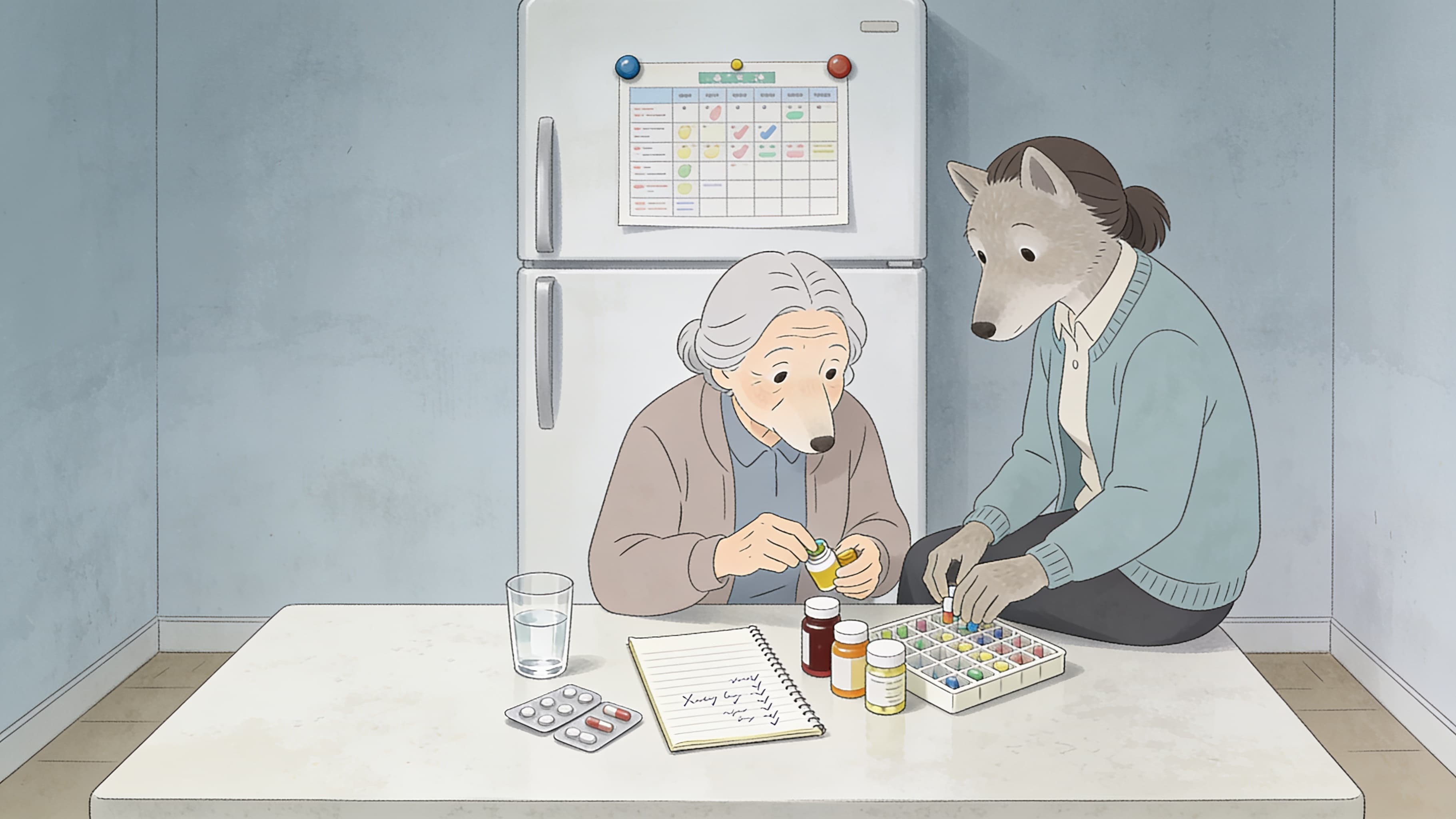
The Hidden Dangers of Medication Mismanagement
The numbers are stark. The CDC reports that adverse drug events send more than 700,000 older adults to emergency departments each year. Nearly 40% of adults over 65 take five or more prescription medications, a pattern called polypharmacy that sharply raises the risk of harmful drug interactions, according to the National Institute on Aging.
The most common errors are deceptively simple: a missed dose, a duplicate therapy prescribed by two specialists who don't communicate, a dangerous interaction between a blood thinner and an over-the-counter pain reliever. Many families never see the problem forming because a senior may visit a cardiologist, a neurologist, and a primary care doctor, each writing prescriptions without a full picture of what the others have ordered.
This article lays out a concrete system: how to compile a complete medication list, choose a tracking method, coordinate across doctors and pharmacies, and recognize when professional help is needed.
Conduct a Brown Bag Medication Review
The first step is deceptively low-tech. Gather every prescription bottle, OTC product, vitamin, eye drop, and herbal supplement the senior uses and put them all in a bag. This "brown bag review" is a standard practice recommended by pharmacists and geriatricians because it forces completeness.
For each item, record:
- Drug name (brand and generic)
- Strength and dose (e.g., 10 mg, one tablet)
- Frequency (twice daily, as needed)
- Prescribing doctor
- Pharmacy where it's filled
- Reason for the medication ("blood pressure," "cholesterol")
Organize this into a master medication list. A printable weekly medication log can help, but recognize that not every family has a printer and not every senior can read small type. Alternative formats that work well: a large-font laminated chart posted on the refrigerator, a pre-filled log that many pharmacies will print and mail at no cost if you ask, or even a simple voice memo recorded on a phone listing each drug and its schedule.
Bring this list to every doctor visit. Update it the same day any medication changes.
If You're Overwhelmed or Caregiving from a Distance
Many families cannot realistically commit to weekly logkeeping. Consider a daughter coordinating her father's care from 500 miles away while working full time. For overburdened caregivers, here is a minimal viable approach:
- Use a single shared note (Apple Notes, Google Keep, or any basic app) where any family member can log a medication change the moment it happens. No special software needed.
- Call the pharmacy once a month and ask the pharmacist to review the current prescription list on file. Many pharmacists will do a brief phone reconciliation at no charge.
- Designate one family member as the medication point person, even if they live remotely. That person's only job is keeping the shared list current.
Perfect tracking is not the goal. A single, shared, reasonably current list is vastly better than scattered bottles and guesswork.
Choose a Daily Tracking System
The right system depends on the senior's abilities. Before buying anything, assess four factors:
| Factor | What to Look For |
|---|---|
| Vision | Can they read pill labels? If not, consider color-coded or tactile organizers. |
| Manual dexterity | Can they open small compartments? Look for large-lid organizers. |
| Cognitive level | Mild forgetfulness vs. significant memory loss changes everything. |
| Number of daily doses | One pill at breakfast is different from eight pills across four time slots. |
Choose a basic weekly pill organizer if the senior has mild forgetfulness, takes medications at one or two set times, and can open compartments independently.
Choose a smart pill dispenser with alarms and locked access if the senior has notable memory loss, takes medications on a complex schedule, or has a history of double-dosing. These devices dispense only the correct pills at the correct time.
Choose a caregiver medication app (such as Medisafe or CareClinic) if a family member can set it up and the senior or a nearby caregiver has a smartphone. Apps send reminders and let remote family members monitor adherence.
Choose a voice-recording system if the senior has low vision or limited literacy. A daily alarm on a phone paired with a recorded message ("Take your white heart pill and your small yellow pill") can be surprisingly effective.
No single tool works for everyone. The best system is the one that actually gets used.
Master Medication Reconciliation
Medication reconciliation means confirming that every doctor and pharmacy has the same accurate list. It sounds straightforward. In practice, it breaks down constantly, especially after a hospital stay. Research consistently shows that medication errors spike at transitions of care: hospital to home, home to rehab, rehab to assisted living.
At every medical visit, present the current list and ask two direct questions:
- "Is each of these medications still necessary?"
- "Are there any interactions between these drugs?"
Here is a script you can adapt: "Dr. Smith, I want to make sure you have Mom's exact medication list. Can we review it together and check for any problems or drugs she no longer needs?"
The Gatekeeper Strategy
A common frustration: multiple specialists each prescribe medications but none will reconcile or override another doctor's orders. The fix is to designate the primary care physician as the medication gatekeeper.
Ask the PCP directly: "Would you be willing to serve as the central coordinator for all of Dad's medications? We'd like you to review what each specialist prescribes and flag any conflicts." Most PCPs will agree. You may need to sign a records release so the PCP can receive notes from every specialist. This single step prevents more errors than any pill organizer.
Medicare's Medication Therapy Management Program
Medicare Part D covers Medication Therapy Management (MTM) for qualifying beneficiaries. Eligibility typically requires three or more chronic conditions, five or more Part D covered drugs, and annual drug costs above a set threshold. Be aware: most MTM is conducted by phone, not in person, and the review may be limited in scope. If your family member does not qualify, ask the pharmacist directly for a one-on-one comprehensive medication review. Many state pharmaceutical assistance programs also offer free consultations.
Leverage Pharmacy Services
Pharmacies offer tools that many families never hear about:
- Blister packs (bubble packs): The pharmacy pre-sorts pills by day and time into sealed, labeled compartments. This nearly eliminates wrong-dose errors. Ask your pharmacist if they offer this service; many do at no extra charge.
- Medication synchronization (med sync): All prescriptions are aligned to refill on a single day each month. No more juggling five different refill dates.
- Auto-refill and mail-order pharmacy: For maintenance medications (blood pressure, cholesterol), auto-refill or 90-day mail-order prevents gaps.
When evaluating Part D plans, keep in mind that preferred pharmacies often have lower copays. Use the Medicare Plan Finder during open enrollment to compare true out-of-pocket costs.
Troubleshoot Common Challenges: Dementia, Swallowing, and Cost
Dementia
For seniors with dementia, unsupervised medication access is a safety risk. Use a locked medication box, supervise every dose, and ask the prescribing doctor to discontinue any drug that is no longer clearly beneficial. Simplifying the regimen is one of the most effective safety measures. For broader guidance on safety planning, see our article on when a parent has dementia and lives alone.
Swallowing Difficulties
If a senior struggles to swallow pills, ask the pharmacist about liquid formulations, crushable tablets (not all pills can be safely crushed), or smaller pill sizes. Never crush or split a medication without pharmacist approval, as some coatings control how the drug is released.
Cost Barriers
Medication costs derail adherence. Practical steps:
- Ask for generic alternatives at every prescription. The savings can be dramatic.
- Apply for patient assistance programs offered by drug manufacturers. Most major brands have them.
- Check eligibility for the Medicare Part D Low-Income Subsidy (LIS), also called Extra Help, which can reduce premiums, deductibles, and copays significantly.
- Watch for the Part D coverage gap. In 2025, the Inflation Reduction Act capped annual out-of-pocket Part D spending at $2,000. Verify the current cap for 2026 during open enrollment using the Medicare Plan Finder, and plan your budget accordingly. Families who do not check this each year risk unexpected costs when a new drug pushes spending higher than anticipated.
Consolidate doses when possible. Ask the doctor: "Can any of these medications be combined into fewer daily doses?" Fewer pills at fewer times means fewer chances for error.
Know When to Bring in Professional Help
Some red flags signal that home medication management is no longer safe:
- Repeatedly missed doses despite reminders
- Unexplained weight loss, increased confusion, or frequent falls
- Emergency visits related to medication side effects or overdoses
- The caregiver feels unable to keep up with the complexity
Professional options include:
- Home health nursing: A registered nurse can set up weekly pill boxes, reconcile medications, and train family caregivers.
- Assisted living medication management: Many communities offer staff-administered medication programs. When touring, ask specifically about staff training protocols, how medication errors are tracked and reported, and how controlled substances are handled. Our guide on evaluating senior care staff covers the right questions in detail.
- Pharmacist consultations: Even outside of MTM, a pharmacist can provide a thorough one-time review.
A script for starting the family conversation: "I've noticed Mom has missed her heart medication several times this month. I think we should look into getting help, whether that's a home health nurse or a community that manages medications for her. Can we talk about what makes sense?"
Create Your Family Medication Safety Plan
Here is a five-step checklist you can act on this week:
- Complete a brown bag review and create a master medication list in whatever format works for your family (printed log, shared digital note, laminated chart, or pharmacy-printed list).
- Choose a tracking system based on the senior's vision, dexterity, cognition, and schedule. Set it up with all current medications.
- Schedule a medication reconciliation appointment with the primary care doctor within the next two weeks. Ask that doctor to serve as the medication gatekeeper across all specialists.
- Contact the pharmacy to ask about blister packs, med sync, auto-refill, and whether a free medication review is available.
- Share the medication list and this plan with every family member involved in caregiving. Update the list after every change, no matter how small.
For remote caregivers who cannot do all five steps at once: start with steps 1 and 5. A shared, current list that the whole family can see is the single highest-impact action you can take.
This article provides general information about medication management and is not a substitute for professional medical, legal, or financial advice. Consult a physician or pharmacist for guidance specific to your family member's health needs.
Sources & further reading
- Drug Coverage (Part D) · Medicare.gov
- Medicare Plan Finder · Medicare.gov
Related Articles
When Home Care Isn’t Enough: 7 Signs It’s Time for Assisted Living or Memory Care
A practical checklist of 7 signs that home care is no longer safe or sustainable, guiding families toward assisted living or memory care.
Memory Care in Oregon: Licensing, Costs, and What Families Should Look For in 2026
Oregon's memory care costs and regulations explained. How to verify dementia training, compare communities, and budget for 2026.
Private Pay vs. Government Assistance: How Senior Care Actually Gets Paid For
Home care, assisted living, and nursing homes are funded very differently. A plain-language map of private pay versus Medicare, Medicaid, and VA support, setting by setting.